What is GEO (Generative Engine Optimization)?
Published · 2026
Generative Engine Optimization — GEO — is the set of practices that increase the probability that a generative engine (ChatGPT, Perplexity, Gemini, Google's AI Overviews) uses and cites your site in its answers. It does not replace SEO: it extends it to where a growing share of search has moved. Here is what actually changes, the numbers we have, a concrete example, and where to start.
Why GEO exists
For twenty years the goal was to appear among ten blue links. Today part of all searches gets a ready-made answer: the user reads the assistant's summary, sees two or three cited sources, and often clicks nothing. Gartner predicted back in 2024 a 25% drop in traditional search volume by 2026; Ahrefs measured in 2025 roughly a third fewer clicks on the top result when an AI Overview appears. For a business, the question changes: from “how do I rank” to “how do I become one of the answer's sources”.
Being cited has a different value than a click: it is an implicit recommendation. If an assistant answers “best home insurance in Manchester” with your site, the user arrives already trusting you — or searches your name directly right after.

A concrete example
A bakery in Brighton publishes one properly built page on a real question: “Gluten-free cake in Brighton: where to order and what it costs” — the answer in the first three lines, real prices (“from £30 for 8 people, order 3 days ahead”), a marked-up FAQ, and an About page with the baker's name and face.
Six months later, someone asks an assistant “where can I order a gluten-free cake in Brighton?”. The assistant needs concrete, local sources: the bakery's page is the only one answering with numbers, lead times and a verifiable identity — and it gets cited. The competitor with “our cakes, art and passion since 1987” on the homepage is not even considered: there is not one sentence a model could repeat.
That is the whole GEO mechanism in miniature: not a trick, but being the most citable source on one specific question.
GEO and SEO: what stays the same
Almost all the groundwork is identical. Useful, original content, a fast clean site, solid structure, schema markup, authority built over time: all of it serves Google and generative engines alike. If you have done serious SEO, you are not starting from zero.
The data sources overlap too: AI Overviews are Google, and ChatGPT and Perplexity lean on search indexes for anything recent. Ranking well remains the front door to being cited.
What actually changes
The unit of consumption changes: no longer the whole page, but the citable passage. Models extract sentences and blocks — definitions, sourced numbers, FAQs — so every section must hold up even out of context.
The weight of the entity changes: models prefer citing sources they can identify. Who you are, where you operate, who writes: pages like About and the legal notice, consistent Organization markup and a recognizable author become practical factors, not bureaucracy.
And access changes: you must decide whether to welcome AI crawlers. Blocking them protects content from training, but excludes you from the answers; for a local business that lives on visibility, the math almost always lands the other way. The detail few people know: since July 2025 Cloudflare blocks AI crawlers by default on new domains — so many sites have already chosen without knowing it, in the wrong direction.
The numbers we have so far
GEO is young and serious data is scarce — but not zero. The study that coined the term (Princeton and other universities, 2024) tested nine techniques across thousands of queries: adding citations, statistics and sources raised visibility in generative answers by up to roughly 40% — while keyword stuffing made it worse. Hard to imagine a cleaner confirmation of the old rule: substance yes, tricks no.
On the traffic side: OpenAI reported around 800 million weekly users in late 2025, and AI Overviews appear on a growing share of informational searches. The clicks that vanish from the top result (about a third, per Ahrefs) do not come back — they move toward whoever gets cited.
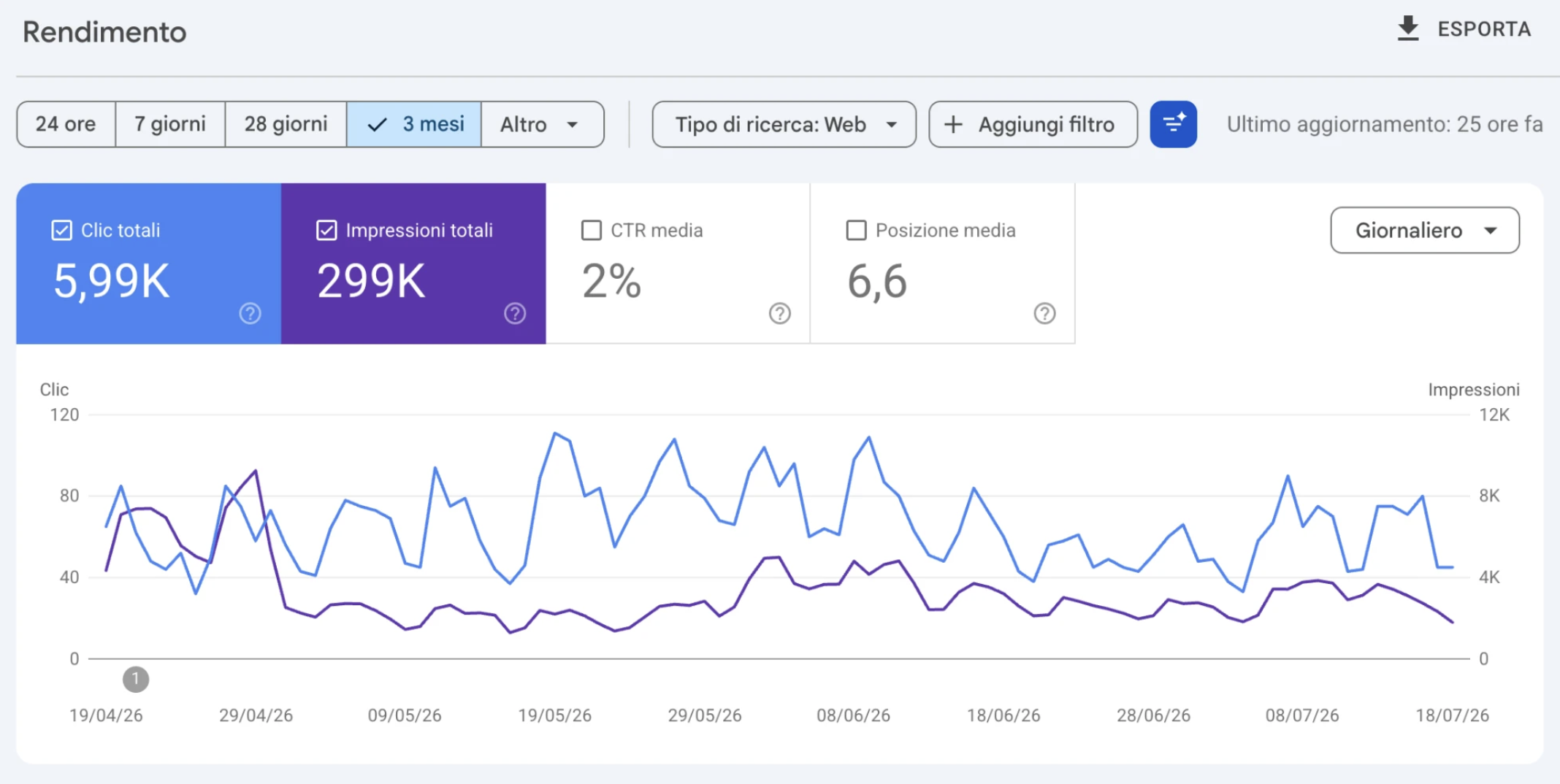
Below, for context, the Search Console of a client site publishing one answer-first article a week for three months: organic traffic and AI citations grow on the same pages, because the practices are the same.
GEO in practice: where to start
Four moves, in this order:
- Check access: a robots.txt that does not block GPTBot, ClaudeBot or PerplexityBot, no CDN-level block (check your Cloudflare settings), and an llms.txt at the root describing the site and linking the key pages.
- Make what you publish citable: the answer in the first sentence of every section, H2s phrased as real questions, FAQs with FAQPage markup, numbers always with a source and a date, visible last-updated dates.
- Build the entity: a page that says clearly who you are and what you do, real legal details, the same name and data everywhere, Organization markup with a stable identifier.
- Cover your topic consistently: one article a week on your customers' real questions is worth more than ten generic pages published once and never touched again.
How to measure GEO
Measurement is still handcraft, and anyone promising precise AI-click dashboards is selling smoke. What works today: periodically ask the assistants your industry's questions and note the cited sources, watch Analytics for referrals from chatgpt.com and perplexity.ai, track the growth of brand searches and, for AI Overviews, the impressions of informational queries in Search Console.
An honest note
GEO is young: generative engines change fast and nobody can guarantee a citation — just as nobody could ever guarantee the first spot on Google. Distrust anyone selling certainty. What can be done seriously is raising the probability: citable content, a clear entity, open access, consistency. It is the same patient game as SEO — played for the new readers too.
Frequently asked questions
›Does GEO replace SEO?
No. The foundation is the same — useful content, clean tech, authority — and generative engines partly lean on the same search indexes. GEO adds a layer on top: making content citable and the entity recognizable.
›Should I block AI bots to protect my content?
It is a trade-off: blocking keeps content out of training, but also out of generative answers. For most local businesses visibility is worth more than protection; if you sell the content itself, the math may differ. Either way, check your CDN: since July 2025 Cloudflare blocks AI crawlers by default on new domains.
›How long until I see results?
Timelines similar to SEO: weeks for indexing, months for topical authority. AI citations arrive gradually, usually alongside growing organic rankings on the same questions.
›Do I need a dedicated GEO tool?
No: you need well-written content, correct schema markup, a robots.txt open to AI crawlers and an llms.txt. Tools mainly help scale content production — the part that genuinely takes time.
›Does GEO work for a small local business too?
Yes — often better than for big players: assistants look for concrete, local answers, and a page with prices, lead times and a verifiable identity beats the generic portal. The hard part is not size: it is publishing consistently.