How to write articles for SEO and for ChatGPT
Published · 2026
In 2026 an article has two readers: the people who arrive from Google, and the generative engines — ChatGPT, Perplexity, Gemini, AI Overviews — that read your page and decide whether to cite it in their answers. The good news is that the two optimizations overlap far more than people think: what a language model needs in order to cite you is, in large part, what Google has rewarded for years. This guide shows how to write articles that work for both, with concrete examples and the numbers we actually have.
Why you now write for two readers
A growing share of searches no longer ends with a click on a blue link: it ends with a generated answer, inside ChatGPT or at the top of Google. Some scale: OpenAI reported around 800 million weekly ChatGPT users in late 2025, and Gartner predicted back in early 2024 that traditional search volume would drop 25% by 2026 because of AI assistants.
And when the assistant answers, traffic changes route: a 2025 Ahrefs study measured roughly a third fewer clicks on the top organic result when an AI Overview appears above it. Translation: you can rank #1 on Google and still lose the reader, if the generated answer cites someone else.
That answer cites a handful of sources. Either you are one of them, or you do not exist for that user. The good news: generative engines do not cite at random. They pick pages that answer directly, verifiably and with clean structure — qualities you can engineer, exactly the way you have always engineered articles for classic SEO.

The plumber test
Take a plumber in Bristol with a page titled “Boiler leaking water: what to do right now”. Version one, the kind you read everywhere: “Leaks can have many causes. Every situation is different and should be assessed by a professional. Contact us for a visit.” True, useless, uncitable: it answers nothing.
Version two: “If your boiler is leaking, close the filling loop valve under the boiler and switch it off. If the pressure gauge reads above 2.5 bar, the likely culprit is the pressure relief valve or the expansion vessel: a typical repair costs £80–£200. If it leaks even when off, call someone the same day.” Ask an AI assistant “my boiler is leaking, what do I do?” and guess which of the two pages it can quote word for word.
The rest of this guide is the method behind version two: answer first, with real numbers, in sentences that stand on their own. You still sell the visit — in the last line, not instead of the answer.
The structure that works for both
The most important rule: answer first. The first paragraph under the title must contain the complete answer to the article's question, in two or three self-sufficient sentences. Google uses it for featured snippets; a language model can lift it and cite it as-is. Details, edge cases and context come after. It is the journalist's inverted pyramid, rediscovered because one of your readers is now a machine.
Write your H2s as real questions, phrased the way a customer would ask them: “How much does it cost?”, “Do I need an accountant?”, “How long does it take?”. Generative engines work in question-and-answer units: every section that mirrors a real question is a citable unit.
One idea per paragraph, short paragraphs, lists where enumeration helps. A wall of text gets skipped by people and badly summarized by models.

Writing sentences a model can cite
Models cite sentences that stand alone. “Chart work is only required beyond the 12-mile line” is citable; “as we said above, it depends” is not. Re-read your key sentences asking: if this sentence appeared alone inside a ChatGPT answer, would it be correct, complete and attributable to me?
This is not just intuition: the academic study that coined the term GEO (Princeton and other universities, 2024) measured that adding citations, statistics and sources to a page increases its visibility in generative answers by up to roughly 40%. The same things a good editor always asked you for: numbers, sources, firm statements.
In practice, three typical rewrites:
- From “prices vary a lot” to “in 2026 an average policy for a one-bed flat in London starts around a thousand pounds a year, according to the major insurers' price lists”: the number with a source and a date is citable, the vagueness is not.
- From “we are industry leaders” to “we install about 120 boilers a year across Bristol”: the first is invisible marketing, the second is a fact a model can repeat.
- From “it depends” to “it depends on three things: X, Y and Z — and in most cases X decides”: taking a position, where you have the competence to, is what makes a page worth citing.
The technical layer: schema, dates, llms.txt
Article and FAQPage markup in JSON-LD remains the most reliable way to tell machines what is on the page: properly marked FAQ blocks are among the content most often lifted into generative answers. A title around 60 characters with the keyword up front, and a meta description that promises the answer.
Show a real last-updated date and actually refresh content that ages: models weigh freshness when choosing between similar sources, and a 2023 article loses to one updated for 2026.
Then the point almost everyone misses: make sure AI crawlers can read you at all. GPTBot (OpenAI), ClaudeBot (Anthropic) and PerplexityBot respect robots.txt — and since July 2025 Cloudflare blocks AI crawlers by default on new domains. A huge number of sites are invisible to ChatGPT without their owners knowing. Check robots.txt and your CDN settings, and add an llms.txt file at the root: a description of the site plus links to the key pages, so generative engines understand who you are.
Being a source, not just a page
Generative engines prefer citing recognizable entities: a site with a real author, a page explaining who is behind it, consistent contact details and the same Organization markup everywhere. If you write about an industry you actually work in, say so: first-hand experience is the E-E-A-T signal neither Google nor the models let you fake.
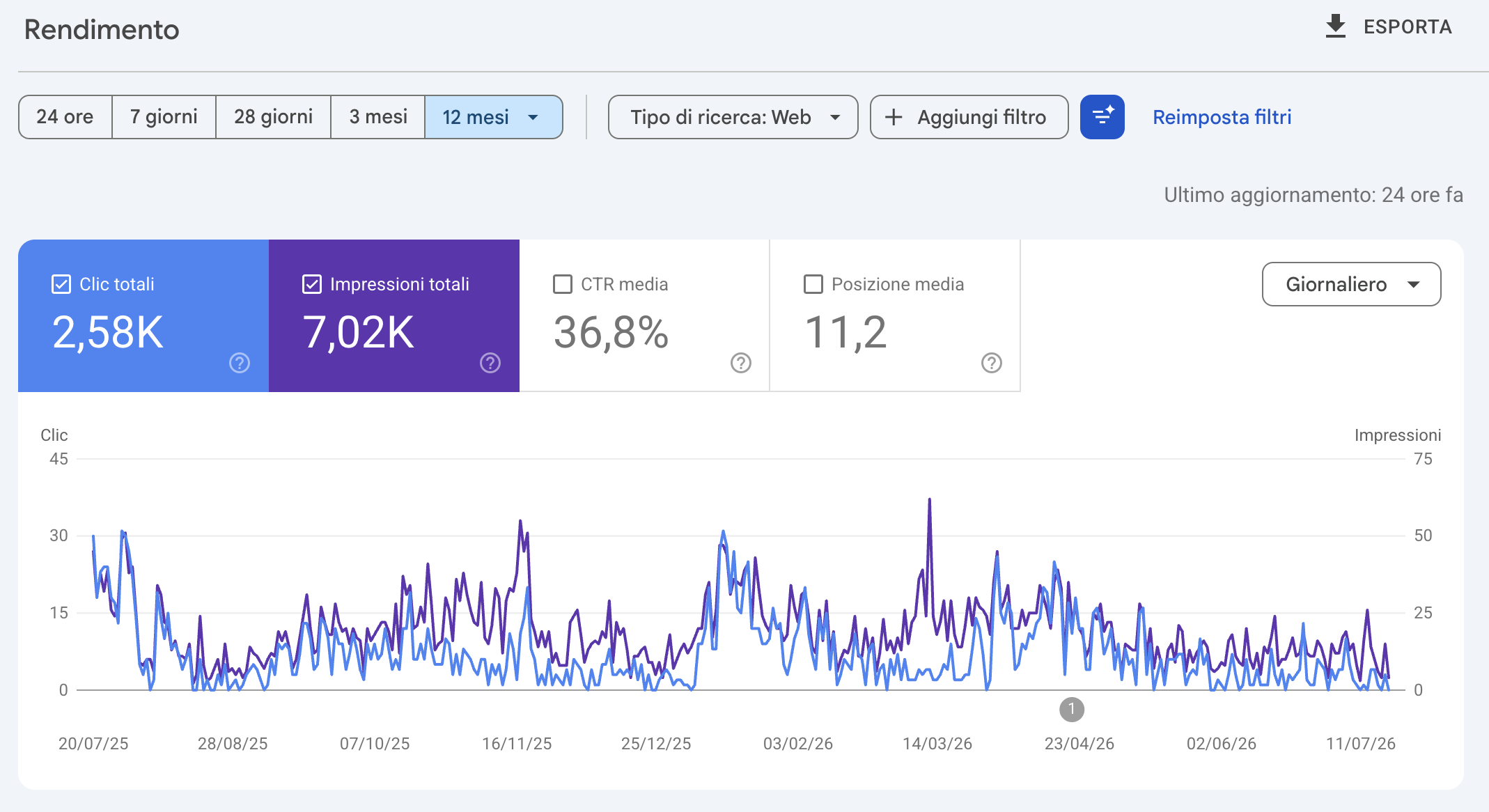
And consistency counts as much as quality: a blog that publishes weekly on one theme builds, article by article, the topical coverage that makes your domain the obvious source on that subject. That is not theory — below is the Search Console of a client site that has published consistently for a year.
The most common mistakes
Three proven ways to never get cited:
- Keyword stuffing: repeating the keyword in every sentence makes the text worse to read and helps no model. Write for the question, not the keyword.
- Half answers: articles that circle the question for eight hundred words without ever answering it. Suspense works in thrillers; neither Google nor ChatGPT rewards it in an article.
- Photocopy content: if your article says what the first ten results already say, there is no reason to cite you specifically. Add what only you know: your data, your cases, your experience.
Frequently asked questions
›Does ChatGPT actually read my website?
Yes — if its crawlers are not blocked. OpenAI uses GPTBot and respects robots.txt; the same goes for ClaudeBot (Anthropic) and PerplexityBot. Watch your CDN: since July 2025 Cloudflare blocks AI crawlers by default on new domains, so many sites are invisible to assistants without knowing it.
›Does Google penalize AI-written articles?
Google states it evaluates the quality and usefulness of content, not the tool. A correct, useful AI article with real experience inside can rank; a poor human one cannot. The real risk is generic content with no review and no first-party data.
›How often should I publish?
Consistency beats volume: one good article a week for a year is worth more than twenty articles in a month followed by silence. Steady topical coverage builds domain authority — for Google and for generative engines alike.
›How long should an article be?
As long as a good answer requires — usually 1,000 to 2,000 words for a real question. Length itself is not a factor: a long, empty article loses to a shorter one that answers immediately and brings sourced data.
›How do I know if ChatGPT or AI Overviews cite me?
There is no “Search Console for AI citations” yet. In practice: ask the assistants your industry's questions and check the cited sources, watch Analytics for referrals from chatgpt.com and perplexity.ai, and track the growth of searches for your brand.